
Best Urdu Calligraphy Fonts for Wedding Cards & Invitations

A wedding card is read once and kept for years — so the best Urdu calligraphy fonts for wedding cards are the elegant, traditional faces that make names look ceremonial: Jameel Noori Nastaleeq for the couple’s names, Zohra Unicode for decorative headings, SF Koonj Regular for poetry and couplets, and UL Sajid Heading for section titles. This guide covers the picks by ceremony — nikah, walima, mehndi — the three-role card system, and the printing details that keep gold-foil Urdu text crisp.
Different medium? This is the wedding cards and invitations guide. For video covers see best Urdu fonts for YouTube thumbnails, and for outdoor advertising best Urdu fonts for billboards.
Table of Content
Table of Contents
What Makes a Font Good for Wedding Cards
- Elegance: the card announces a celebration — calligraphic Nastaliq and decorative hands give it the premium, ceremonial feel.
- Name legibility: the couple’s names are the most-read line on the card — they must be beautiful AND readable at a glance.
- Traditional register: wedding Urdu leans classical — the expected voices are Nastaliq and formal Naskh, not playful display faces.
- Print behaviour: gold foil, embossing and letterpress punish thin strokes — the font needs sturdy letterforms that survive the press.
A wedding card typically uses 2–3 fonts: one for the names, one for headings, one for the event details. More than that looks cluttered.
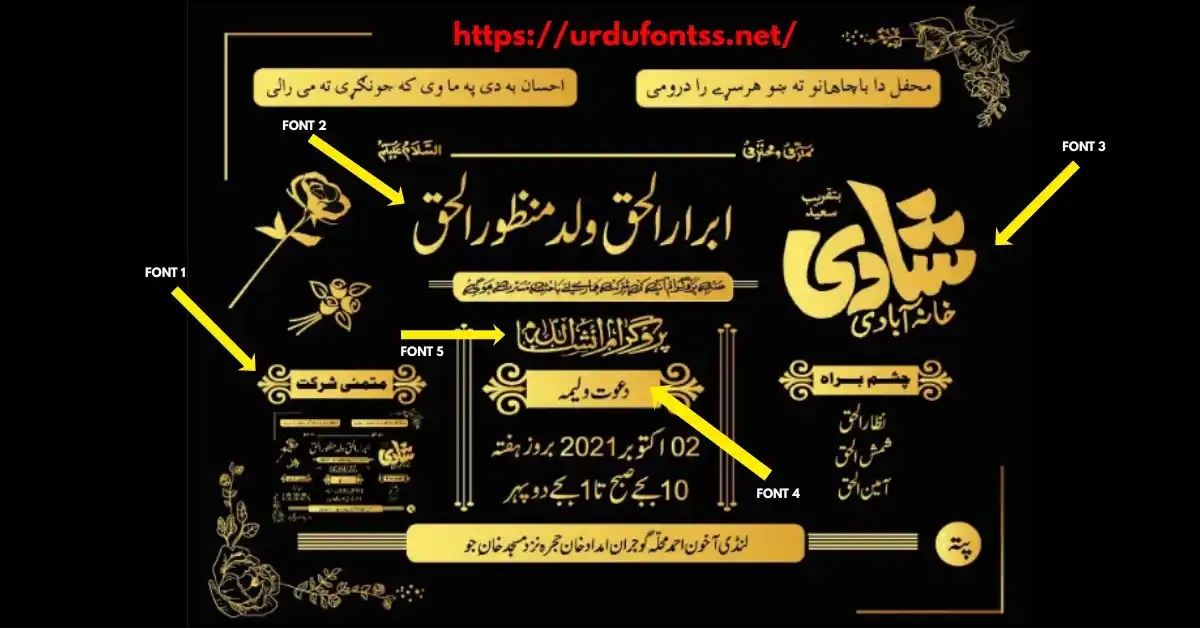
Top Urdu Calligraphy Fonts for Wedding Cards
1. Jameel Noori Nastaleeq — best for the couple’s names
The ceremonial standard. Jameel Noori Nastaleeq gives the bride and groom’s names the traditional calligraphic weight a wedding card demands.
2. Zohra Unicode — best for decorative headings
For “Shadi Mubarak” banners and section headings, Zohra Unicode brings a softer, ornamental hand that suits festive pages.
3. SF Koonj Regular — best for poetry and couplets
Wedding cards often open with a sher or dua. SF Koonj Regular sets couplets warmly — personal where the names are formal.
4. UL Sajid Heading — best for section titles
Event names and section titles need clear hierarchy — UL Sajid Heading marks “Nikah”, “Walima” and “Mehndi” blocks at a glance.
5. Urdu Naskh Unicode — best for event details
Dates, venues and addresses must be read without effort — Urdu Naskh Unicode keeps the small print clean and even.
Picks by Ceremony: Nikah, Walima, Mehndi
- Nikah cards: most formal — Jameel Noori Nastaleeq for names, Urdu Naskh Unicode for details, minimal decoration. Dignity over ornament.
- Walima invitations: celebratory but formal — Zohra Unicode headings over Jameel names, with a couplet in SF Koonj.
- Mehndi / dholki cards: the playful one — a decorative display face for the event name is acceptable here, with clean Naskh for the details.
- Digital / WhatsApp invites: the same three-role system applies — export as a high-resolution image so the fonts travel with the design.
How to Choose the Right Font for Your Card
- Match the ceremony’s formality: nikah = most traditional, mehndi = most playful.
- Test the names first: set the actual couple’s names in each candidate — some names look better in one hand than another.
- Check foil behaviour: if the card uses gold foil, avoid very thin strokes — they break up in foiling.
- Keep the printer in the loop: send the printer outlined text or an embedded-font PDF — never live text.
How to Download and Install These Fonts
Download each font from its page (linked in the picks above), then install it: right-click → Install on Windows, Font Book on Mac — the PC install guide and Android guide cover both paths. For card design in Canva, see the Urdu fonts in Canva guide.
Design Tips for Wedding Cards
- Hierarchy of three: names largest, headings next, details smallest — the eye should find the couple first.
- Generous white space: elegance needs air — crowded cards look cheap no matter the font.
- Colour restraint: gold on deep maroon, green or navy is the classic; the font does the talking, not the palette.
- Proof the names twice: a misspelt name on a printed card cannot be fixed — have two people check the Urdu spelling.
Common Problems & Solutions
| Problem | Solution |
|---|---|
| Names look plain, not ceremonial | Move the names to a calligraphic Nastaliq (Jameel Noori) and enlarge them |
| Thin strokes vanish in gold foil | Switch to a sturdier face or weight for foiled elements; test a foil proof first |
| Printer substituted a different font | Outline the text or embed fonts in the PDF before sending the file |
| Card looks cluttered | Cut back to the three-role system — names, headings, details — one face each |
Final Words
A wedding card needs three voices: calligraphic Nastaliq for the names, a decorative face for the headings, a clean Naskh for the details — matched to the ceremony’s formality and printed with care. Jameel Noori Nastaleeq for the names, Zohra for the headings, Urdu Naskh Unicode for the small print — download them from their pages, proof the names twice, and the card will look as good as the day deserves.
Frequently Asked Questions (FAQs)
Which Urdu font is best for wedding cards?
Jameel Noori Nastaleeq for the couple’s names, Zohra Unicode for decorative headings, and Urdu Naskh Unicode for the event details — one face per role.
Are these wedding card fonts free?
The fonts are free to download; for a printed card run, check each font’s licence terms to confirm the usage is covered.
How many fonts should a wedding card use?
Two to three — one for names, one for headings, one for details. More than that looks cluttered.
Can I use these fonts in Canva for my card?
Yes — Canva’s paid plans let you upload custom fonts. Upload the TTF, then design the card with your uploaded faces.
Which font is best for the bride and groom’s names?
Jameel Noori Nastaleeq — its calligraphic Nastaliq gives names the ceremonial weight a wedding card needs.
What font size works on a wedding card?
Names largest (24pt+), headings next, details at a comfortable 10–12pt — and always proof a printed sample before the full run.
Why does my gold-foil Urdu text break up?
Thin strokes fail in foiling — use a sturdier face or weight for foiled elements and request a foil proof from the printer first.

3 Comments