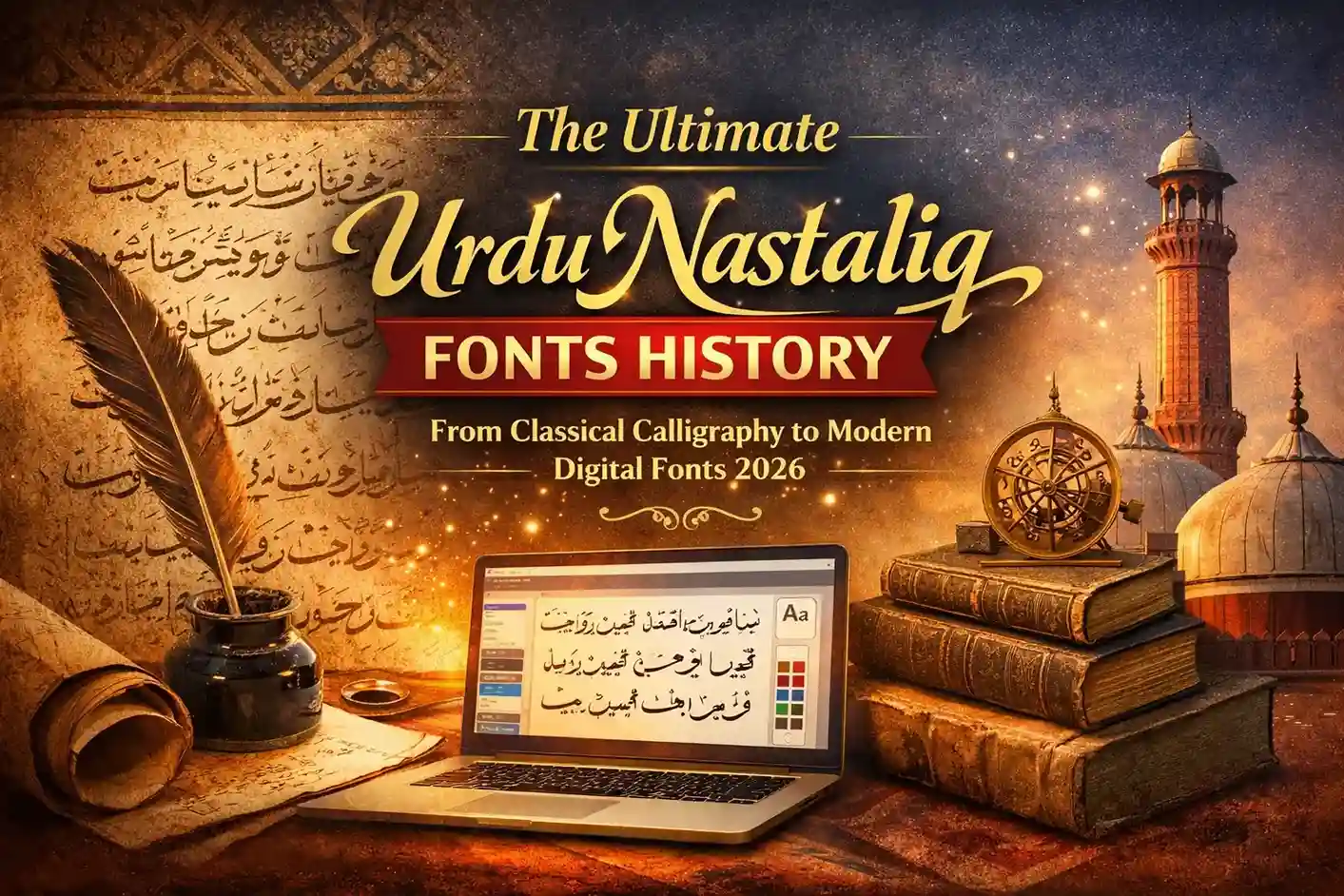
The Complete Urdu Nastaliq Fonts History – 2026 Edition

Table of Content
Table of Contents
Urdu Nastaliq fonts History are the heart of Urdu typography. Known for their beauty, flow, and artistic elegance, Nastaliq has been used for centuries in poetry, literature, and publishing. Even today, it remains the most loved writing style among Urdu readers worldwide.
In this guide, we explore the complete history of Urdu Nastaliq fonts, from its origin in Persia to its evolution in the Indian subcontinent, the challenges of printing, modern digital fonts, and why it remains so important for Urdu typography today.
Origin of Nastaliq Script
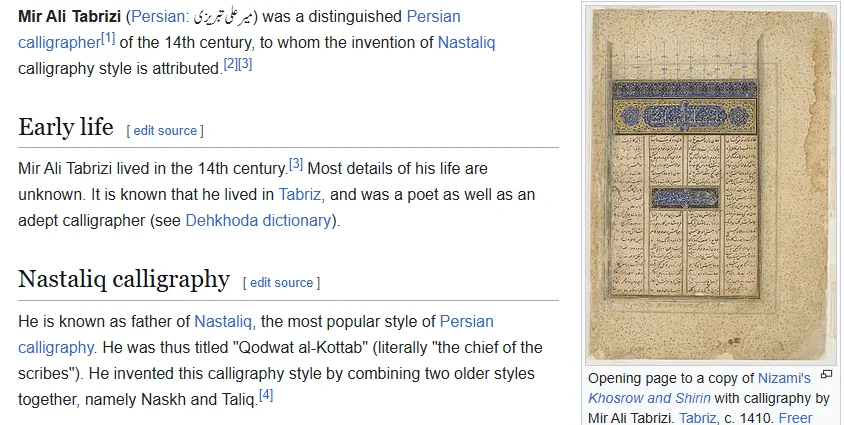
The Nastaliq script originated in 14th-century Persia (Iran) and is one of the most elegant and artistic writing styles in the Islamic world. Its creation is traditionally attributed to Mir Ali Tabrizi, a distinguished Persian calligrapher of the late 14th and early 15th centuries.
Nastaliq was developed by blending two classical scripts:
- Naskh – known for its clarity and readability
- Taʿliq – known for its cursive, hanging strokes
The name Nastaliq itself comes from Naskh-i Taʿliq, meaning a “suspended Naskh,” reflecting the flowing, hanging quality of the letters. Some scholars, like Elaine Wright, note that Nastaliq may have evolved gradually among scribes in Shiraz and may have been derived primarily from Naskh before being perfected by Mir Ali Tabrizi.
Its diagonal flow and elegant curves made it ideal for Persian poetry and later for Urdu literature, providing both beauty and readability.
Mir Ali Tabrizi – The Father of Nastaliq
Mir Ali Tabrizi is widely regarded as the master who canonized Nastaliq. He refined earlier experiments by Persian scribes, setting clear rules for proportions, line thickness, and spacing. His style became the gold standard, influencing generations of calligraphers.
Mir Ali’s students, including ʿUbaydallah Tabrizi and Jafar Tabrizi, carried forward his legacy, spreading Nastaliq across Persia and eventually into the Indian subcontinent.
Nastaliq and the Rise of Urdu Language
During the Mughal era, Persian culture and language spread across the Indian subcontinent. As Urdu developed, Nastaliq naturally became its primary writing style.
By the 16th to 18th centuries, Nastaliq was widely used in:
- Poetry and literature
- Royal court documents
- Religious manuscripts
- Historical records
Legendary Urdu poets like Mirza Ghalib, Allama Iqbal, and Mir Taqi Mir helped solidify Nastaliq as the visual identity of the Urdu language.
Challenges of Printing Urdu Nastaliq Fonts
Printing Nastaliq has always been challenging due to its complexity:
- Letters change shape depending on position
- Thousands of ligatures are required
- Text flows diagonally instead of straight lines
Before computers, Urdu newspapers and books relied on hand-crafted metal types, making printing slow and expensive. Despite these difficulties, Nastaliq remained the preferred script for Urdu publications.
Digital Revolution of Urdu Nastaliq Fonts History
The digital era transformed Urdu Nastaliq typography. The biggest breakthrough came in the late 20th century with the development of fonts like Noori Nastaliq, supported by the Government of Pakistan.
Noori Nastaliq became widely used in:
- Urdu newspapers (e.g., Daily Jang)
- Books and magazines
- Desktop publishing
With OpenType font technology, Nastaliq fonts gained:
- Smart ligatures
- Contextual letter shaping
- Better line flow
This allowed Nastaliq to flourish on computers, websites, and mobile devices.
Popular Modern Urdu Nastaliq Fonts
Today, many high-quality Nastaliq fonts are available for free and professional use. Popular fonts include:
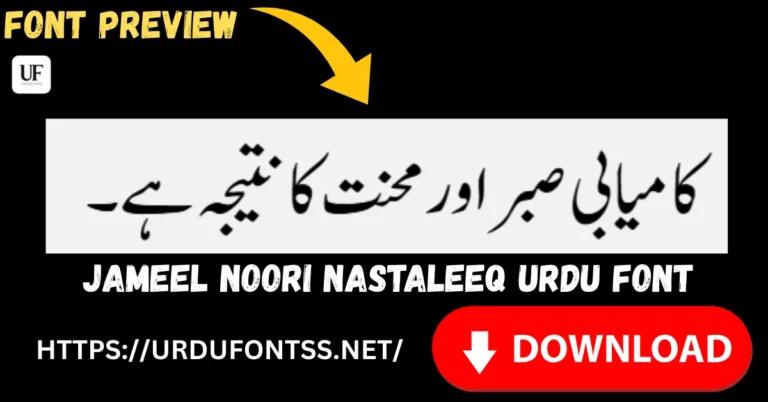
- Jameel Noori Nastaliq
- Mehr Nastaliq
- Alvi Nastaliq
- Faiz Lahori Nastaliq
These fonts are widely used for:
- Websites and blogs
- Graphic design
- Social media posts
- PDFs, books, and ebooks
Importance of Nastaliq in Urdu Typography
Nastaliq is more than just a font—it is a symbol of culture, heritage, and emotion.
Why readers prefer it:
- Preserves the traditional beauty of Urdu
- Feels more natural and expressive
- Enhances poetry and literary content
Even today, Urdu readers emotionally connect more with Nastaliq than with simpler scripts like Naskh.
https://urdufontss.net/fix-urdu-font-rendering-issues-in-browsers/ mein browser rendering issues ka solution hai.
Future of Urdu Nastaliq Fonts
Modern technologies like WOFF2, variable fonts, and font preview tools are making Nastaliq web-friendly and mobile-optimized.
The future focus is on:
- Faster loading websites
- Better mobile readability
- Lightweight font files
- Modern UI/UX without losing traditional style
Platforms like urdufontss.net play a key role in preserving and promoting Urdu Nastaliq typography for future generations.
urdu fonts in adobe illustrator ke liye https://urdufontss.net/category/urdu-fonts/ visit karein.
https://urdufontss.net/best-urdu-fonts-for-instagram-stories-and-posts/ mein Instagram ke liye best fonts hain.
Other Urdu Fonts
Conclusion
The history of Urdu Nastaliq fonts is a journey of art, culture, and innovation. From handwritten Persian manuscripts to modern digital typography, Nastaliq continues to evolve while keeping the soul of the Urdu language alive.
If you want to download Urdu Nastaliq fonts, preview them online, or learn more about Urdu typography, urdufontss.net is your trusted resource.
FAQs – Urdu Nastaliq Fonts
What is the history of Urdu Nastaliq?
The history of Urdu Nastaliq dates back to 14th-century Persia, where Nastaliq evolved from Naskh and Taliq scripts. It later became the primary writing style for Urdu during the Mughal era in the Indian Subcontinent.
Why is Nastaliq important in Urdu typography?
Nastaliq is important because it represents the cultural and literary identity of Urdu. Urdu poetry, books, and newspapers traditionally use Nastaliq due to its beauty and readability for native readers.
What is the difference between Nastaliq and Naskh?
Nastaliq is cursive and diagonal, with complex ligatures, while Naskh is straight and simple, mainly used for Arabic and Quranic text. Urdu readers prefer Nastaliq for general reading.
Which are the best Urdu Nastaliq fonts?
Some of the most popular Urdu Nastaliq fonts include:
Jameel Noori Nastaliq
Mehr Nastaliq
Alvi Nastaliq
Faiz Lahori Nastaliq
These fonts are commonly used for websites, design, and publishing.
Can I download Urdu Nastaliq fonts for free?
Yes, many Urdu Nastaliq fonts are available for free download for personal and commercial use. You can download and preview them from trusted platforms like urdufontss.net.
Are Urdu Nastaliq fonts supported on websites?
Yes. Modern Urdu Nastaliq fonts support web formats (TTF, OTF, WOFF, WOFF2) and can be used on websites with proper optimization for performance and mobile devices.
Why are Nastaliq fonts difficult to design?
Nastaliq fonts are complex because:
Letters change shape based on context
Thousands of ligatures are required
Text flows diagonally
This makes Nastaliq one of the most challenging scripts in digital typography.
Can I preview Urdu Nastaliq fonts online?
Yes. You can use an Urdu font preview tool to type your own text and see it instantly in different Nastaliq fonts before downloading.
Is Nastaliq still relevant in modern design?
Absolutely. Nastaliq remains highly relevant in modern web design, social media graphics, ebooks, and mobile apps, especially for Urdu content.
Free Tools:




4 Comments